

History of the building of the Ministry
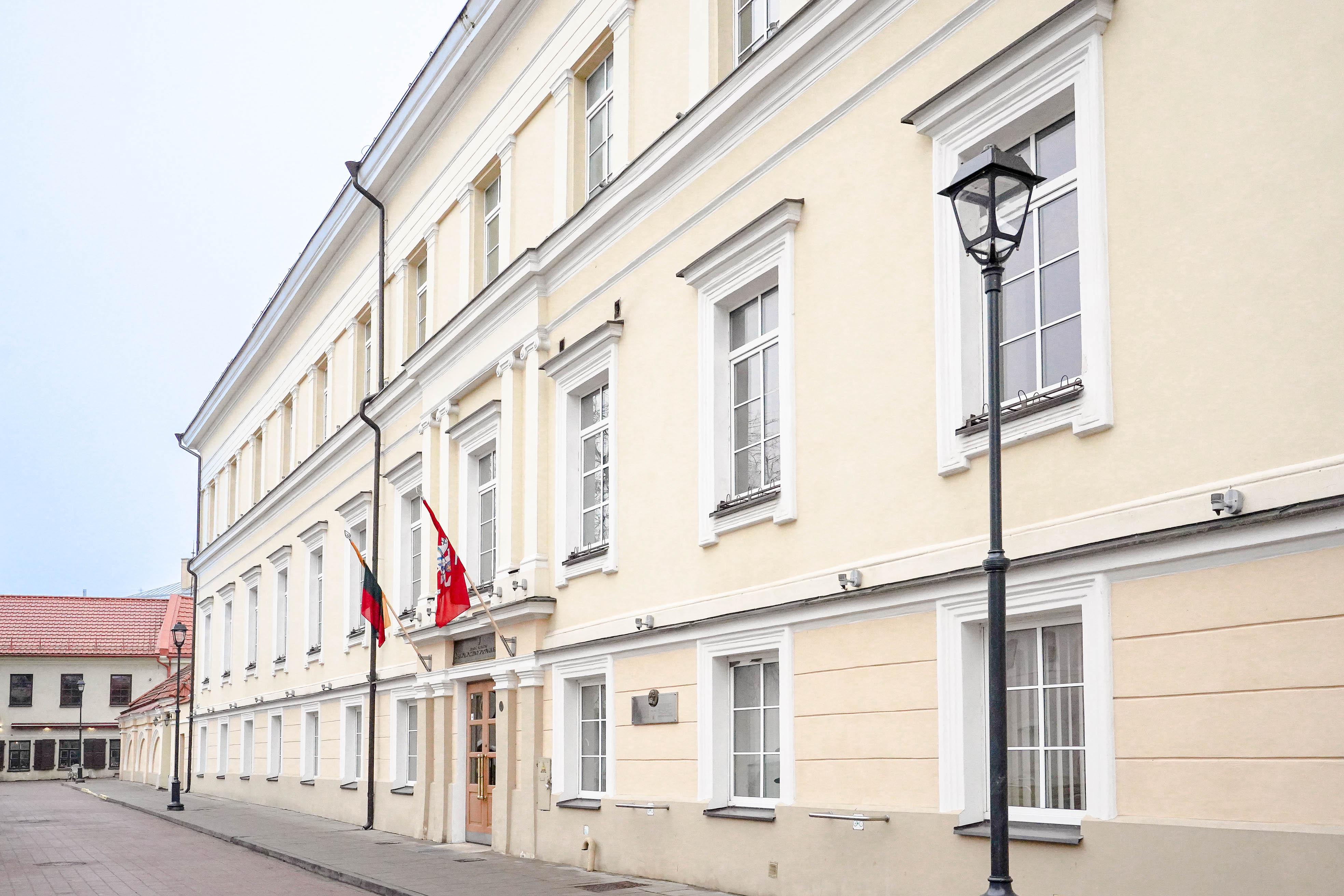
In the mid-16th century, the house of Ivan Hornostay, a nobleman, stood on this site. Later, the house went to Mikalojus Radvila the Brown (Nicholas Radziwill the Brown).
In 1577, Radvila the Brown donated the manor to the Reformed Evangelical community. At that time, the house stood on the current site of the north-western wing and had a clock tower. The land plot was enclosed by a high brick fence with a gate to the current Andriaus Volano Street.
In 1639, the building was vandalised by a crowd of Catholics, as the Reformed were accused of shooting at the Church of St. Michael.
In 1641, the Reformed Evangelical community was moved outside the brick wall.
In the list of buildings in the town in 1755, the building is mentioned but its condition is not described.
At the beginning of the 19th century, the building was acquired by Judge Vincas Mikuličius, who reconstructed it into a three-storey residential house.
In 1804, Vilnius University bought this residential building from Vincas Mikuličius. It was the seat of Vilnius University’s College of Chemistry and home to professors, including Pranciškus Smuglevičius (until his death in 1807) and Andrius Sniadeckis. Pranciškus Smuglevičius resided on the 3rd floor of the south-west part of the north-west wing. At that time, he was the head of the Drawing and Painting Department at Vilnius University. He had a studio and welcomed students there. P. Smuglevičius was the first to train professional artists for Lithuania, the first to support the teaching of drawing and painting with the foundations of a science worthy of the name of a higher education institution. He himself was educated at a serious academic school in Rome and had many years of teaching experience, training professional artists at a private art school in Warsaw.
In 1809-1810, the building was reconstructed according to the design of architect Mykolas Angelis Šulcas, and a chemistry laboratory theatre was built.
In 1820, a brick fence was built according to the design of architect Karolis Podčašinskis.
When Vilnius University was closed in 1832, the building went to the Medical and Surgical Academy of Vilnius.
In 1842, the building housed the dormitory of the first gymnasium in Vilnius. Apparently, the north-eastern wing was built at that time, the hall is divided into two floors and has a ceiling in its dome.
In 1924, the palace was reconstructed according to the design of architect Juljusz Kłos and adapted for the educational curatorial office. Then a new main entrance and a new representative staircase with columns in the north-eastern part of the north-western wing were added, the metal roof from the 19th-century over them was removed, and a pilaster framed portal was built over two floors. The interior was also changed considerably. Many of the doors were bricked up, furnaces rebuilt, stairs made, and two pairs of columns added. The hall was restored (floor slabs removed, windows replaced with niches, two arched windows cut out for the hall lighting, similar to the one that was bricked up during the construction of the north-eastern wing). The window was turned into a balcony entrance, a hall portal was made, and furnaces were built in aligned niches. The front door of the hall was decorated with column motifs, the two doors in the west wall (niches) were replaced by one in the middle, the niches, which used to be different in shape, were made look alike and new round furnaces were built inside them.
After the Second World War, the palace became the seat of the Ministry of Education.
In 1974-1975 the building was reconstructed according to the design of Žvaigždras Drėma.
Literature:
· Vladas Drėma. Pranciškus Smuglevičius. Vilnius, 1973
· Vilniaus architektūra. Vilnius, 1985