

History of the Ministry
.png)
A complete system of education, including primary school, high school and university, was set up in Lithuania in the 16th century. There was a strong growth in the network of parochial schools and strengthening of Catholic schools. In 1579, the Jesuit College of Vilnius was reorganised into an academy and granted all the privileges and rights of European universities.
1773 was marked by establishment of a joint Lithuanian-Polish state educational institution, the Educational Commission, which was the first ministry of education (to use the current term) in Europe. Its task was to reform the entire education system and stop the disintegration of the state. After the collapse of the Polish-Lithuanian Union in 1795 and Lithuania’s incorporation into the Russian Empire, the Educational Commission ceased to function.
During the period of declaration and consolidation of the independent state of Lithuania (1918-1940), education was based on the foundations of the national culture, following the model of the educational system and pedagogical thought of the Western Europe.
The Ministry of Education and Science started its activities in 1918. It was then called the Ministry of Education, and J. Yčas was the first Minister of Education. The Ministry took charge of 8 gymnasiums, 11 pro-gymnasiums and started setting up new ones. It also set up specific schools, such as schools of horticulture, dairy farming, police, military, music, crafts, etc.
The Ministry took care of the network of schools being established, the publishing of textbooks, the content of education, the training of teachers, and sought to overcome the influence of the Russian school by drawing on the experience of education in foreign countries and by looking for a way to take into account the social and economic situation of the country and the national traditions. In 1922, by the efforts of the enlightened society, a university was founded in Kaunas. In addition to the university, 10 other higher education institutions were eventually established in the Independent Lithuania.
The thriving of education was interrupted by the Soviet occupation. The Lithuanian school was integrated into the Soviet education system: not only the content, but also the form of teaching changed. The entire education system was under centralized control from Moscow. Science in higher education institutions developed in isolation from science in other countries and became ideologised. However, Soviet Lithuania retained the right to teach in mother tongue in schools.
After the restoration of independence in 1990, Darius Kuolys became Minister of Culture and Education in the first government.
In 1994, the Ministry was reorganised: the Ministry of Culture was split off and the Ministry of Education became the Ministry of Education and Science, as the State Service of Science, Study and Technology was merged into it.
On 1 April 1998, the Department of Science and Studies was established under the Ministry of Education and Science. The Department was responsible for the implementation of the country’s policy in science, studies and technology development. In 2002, the Department was reorganised to become one of the departments of the Ministry.
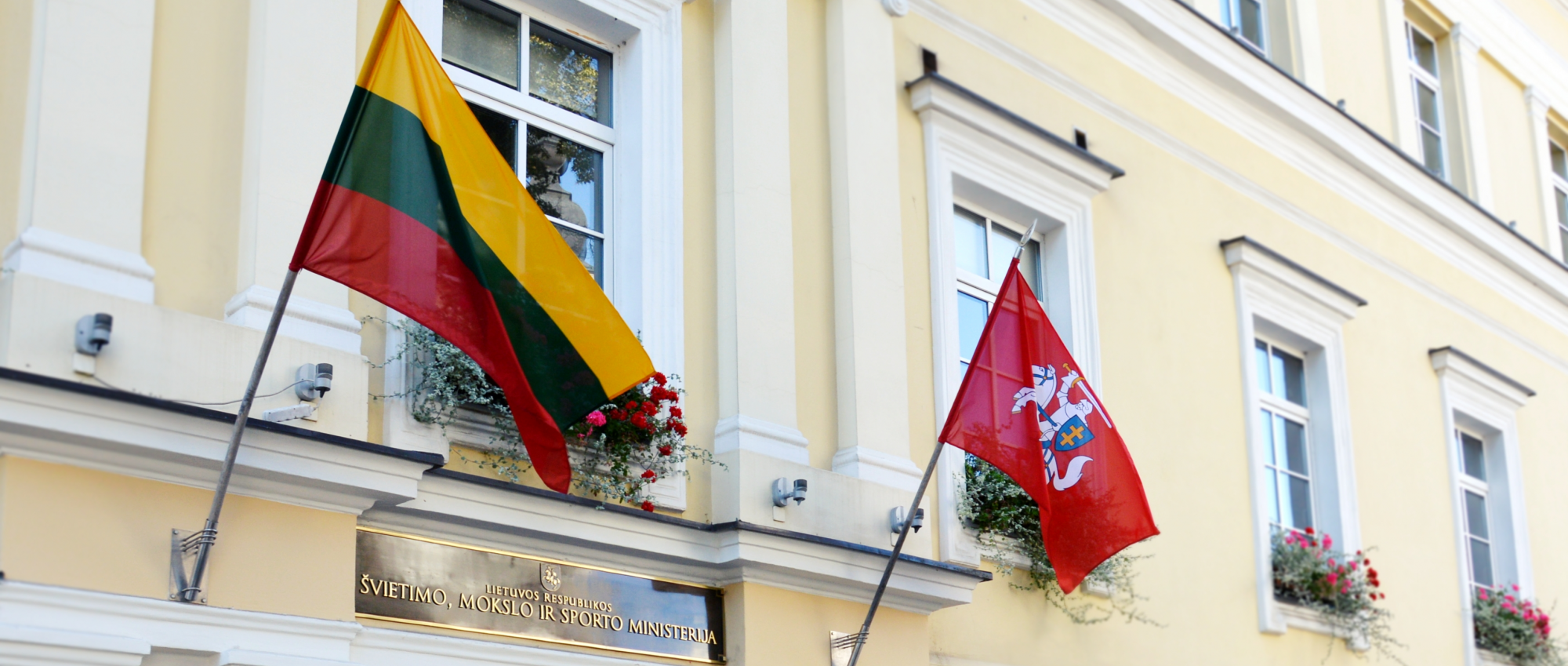
On 1 January 2019, following the dissolution of the Department of Physical Education and Sport under the Government of the Republic of Lithuania, the Ministry of Education and Science was renamed the Ministry of Education, Science and Sport.
The Ministry shapes the implementation of education, science and sport policies, sets strategic goals for the entire system and its subordinate institutions, and lays down rules for the management and funding of the system of education and science. It also sets the necessary quality standards, monitors, analyses and evaluates the outcomes of education, studies and science, and proposes ways to improve the system of education, studies and science to the Seimas, the national policymaker.