

Head of the European Commission’s Joint Research Centre Bernard Magenhann Visits the Ministry of Education, Science and Sport
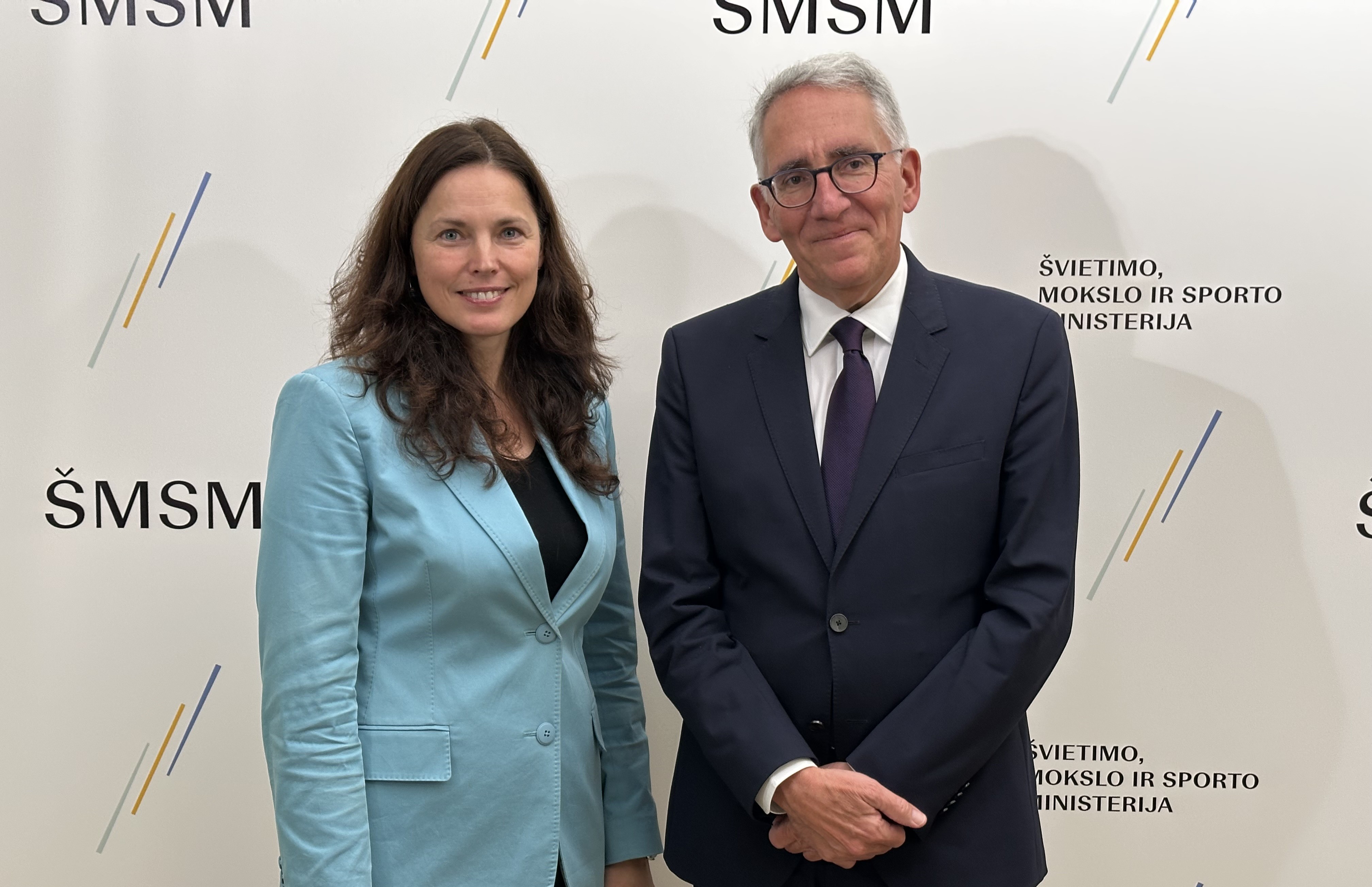
On the 13th of October, the Ministry of Education, Science and Sport hosted Bernard Magenhann, Director-General of the European Commission’s Joint Research Centre (JRC); Jolita Butkevičienė, Director of Science, Innovation and Policy-Making at the JRC; Jakub Dabrowski, JRC Policy Officer and Officer Responsible for Baltic Affairs; and Rytis Martikonis, Head of the European Commission Representation in Lithuania. The meeting focused on Lithuania’s research and innovation priorities and opportunities for closer cooperation with the JRC.
Vice-Minister Regina Valutytė presented the research areas of greatest importance to Lithuania: health technologies and biotechnology, new manufacturing processes, and information and communication technologies. These areas are being developed in line with the country’s smart specialisation priorities. Research into security and defence, as well as dual-use technologies that can serve both civilian and defence purposes, is also becoming increasingly important.
Dual-use research is one of Lithuania’s priorities. The Vice-Minister emphasised the importance of ensuring that funding for research in this field remains available under the future EU Framework Programme for Research and Innovation, Horizon Europe. This would create additional opportunities to develop, test and validate new technologies in practical settings, accelerate their market uptake, strengthen cooperation between science and business, attract international partners and investment, and enhance the country’s competitiveness and security.
The meeting also focused on the opportunities and challenges presented by artificial intelligence (AI). JRC Director-General Bernard Magenhann noted that the rapid advancement of AI is changing societal habits, particularly among younger generations, as well as the labour market. The JRC is studying the impact of AI and what is needed to ensure that these technologies meet the needs of young people. This research could also be relevant to Lithuania’s education system.
The Ministry of Education, Science and Sport and the JRC will continue exploring opportunities for cooperation. One of the aims is to involve Lithuanian research and higher education institutions more actively in joint activities, as these institutions have already expressed strong interest in strengthening their cooperation with the JRC. This would give Lithuanian researchers and institutions greater opportunities to benefit from the JRC’s expertise, exchange data and methodologies, access advanced scientific infrastructure, participate in joint research projects, share research findings, and adapt good practices from other EU Member States to areas of particular relevance to Lithuania.
The European Commission’s Joint Research Centre is a research institution that provides independent, evidence-based insights and advice to support EU policymaking. The JRC’s visit to Lithuania aims to strengthen cooperation and explore how the Centre’s research findings can contribute to more effective, science- and evidence-based policymaking across EU Member States.
Last updated: 14-10-2026
Related news:
Lithuania presented the priorities of Lithuania’s Presidency of the European Schools system at CULT