

PISA 2025: the achievements of 15-year-olds in Lithuania exceed the OECD average
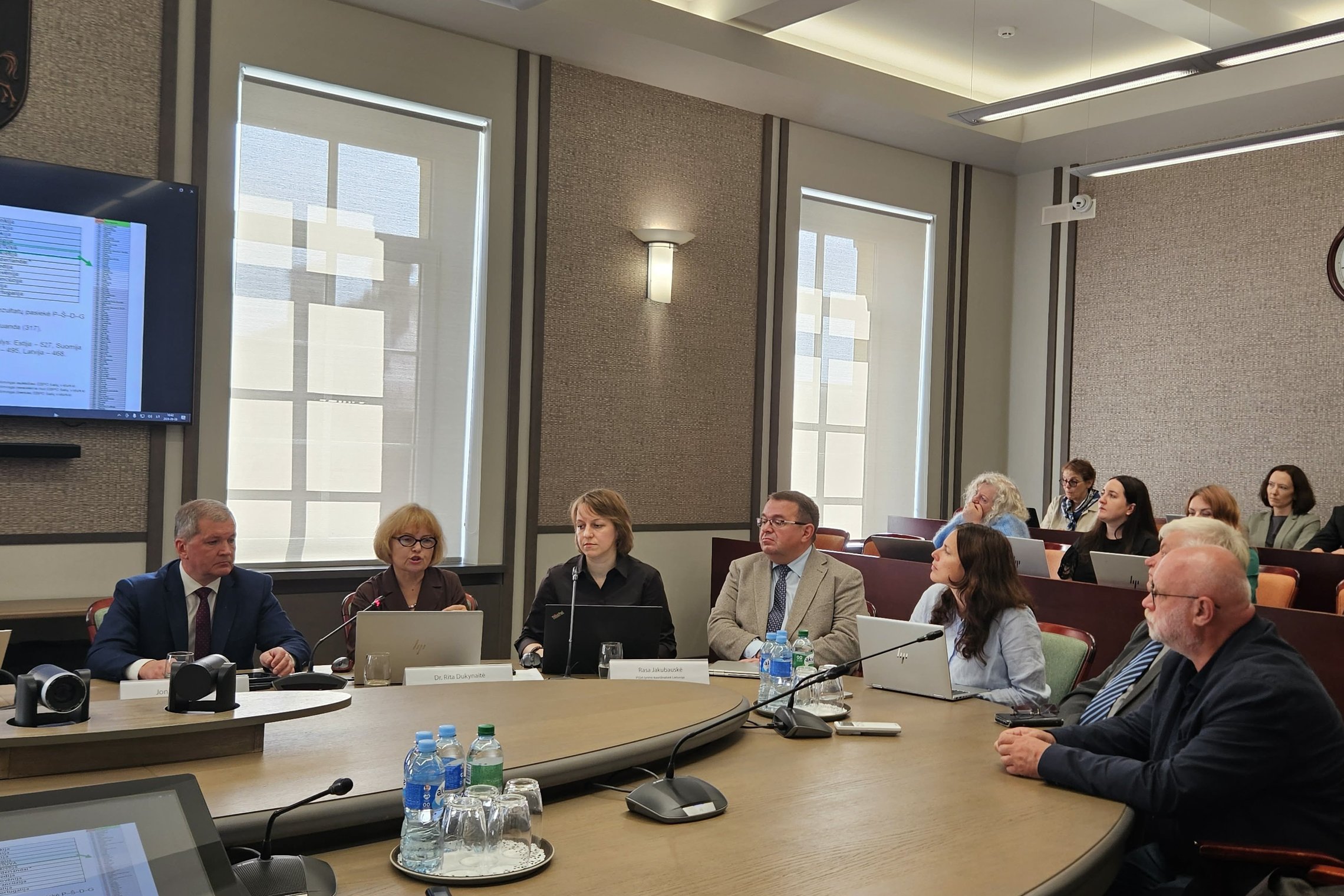
Students in Lithuania score higher than the OECD average in mathematics and science, and close to the OECD average in reading, and are ahead of those of most other countries that participated in the survey. This was revealed through the 2025 PISA (Programme for International Student Assessment) test conducted on 15-year-olds, which was published on September 8.
In the PISA 2025 survey, science served as the major domain, while mathematics and reading were assessed as the two minor core domains. Lithuanian students scored significantly higher than the OECD average in the newly introduced area of computational problem-solving.
“For the first time in the history of Lithuania’s participation in the PISA tests since 2006, the scores of Lithuanian students in all assessment domains are higher than the OECD average.
Lithuania is implementing educational measures aimed at strengthening mathematics performance, application of sciences, reading, and problem-solving. The general education curricula, updated in 2022, provide a foundation for the development of students’ competencies: education is focused not only on the conveying of facts, but also on the ability to analyse, interpret, and apply information in real-life situations. National student achievement tests are also designed with this in mind. Plus, the STEAM centres operating in Lithuania give students the opportunity to learn through exploration, experimentation, and solving real-world problems. The plan for improving mathematics focuses on mathematical reasoning, statistics, and data analysis skills, as well as on strengthening the instructional skills of teachers.
This forms the grounds for a consistent growth of achievements of Lithuanian students and could further improve the country’s performance in upcoming PISA tests,” says Jonas Petkevičius, Vice-Minister of Education, Science, and Sport.
The scores in science performance exceed the OECD average
Lithuania’s performance in sciences (488 points) is statistically significantly higher than the international average for OECD countries by 6 points (OECD average: 482 points). The performance of Lithuanian students is statistically significantly higher than in 62 countries, lower than in 19 countries, and do not differ significantly from 9 countries. Lithuania’s scores do not differ statistically significantly from those of the Czech Republic (490), Belgium (490), Germany (486), the Netherlands (485), Sweden (485), Slovenia (484), France (483), Italy (483), and Portugal (482).
Lithuania stands 20th–29th among the 91 countries that participated in the survey.
The highest achievements in science were found among 15-year-oldsin four Chinese cities and provinces (Beijing, Shanghai, Jiangsu, and Zhejiang) (597) and in Singapore (560). Students from Rwanda scored the fewest points (317).
The number of 15-year-olds in Lithuania who do not reach the second level of performance in science is steadily decreasing. The basic (2nd) level of performance is achieved by 71–80% of 15-year-olds in Lithuania (OECD: 65–74%).
The reading skills of Lithuanian students are above the average for OECD countries
Lithuania’s score (464) is 3 scale points higher than the OECD average (461), but the difference is not statistically significant. Lithuanian students’ reading proficiency scores are statistically significantly higher than those of 63 countries, lower than those of 18 countries, and do not differ significantly from those of 8 countries. The scores of 15-year-olds in Lithuania do not differ from those of Switzerland (470), the Czech Republic (468), Austria (467), Sweden (466), Belgium (466), Germany (465), Portugal (462), and Denmark (460).
Lithuania stands 19th–27th among 90 countries.
Students from Singapore performed the best (535). Students from Rwanda (301) were given the fewest number of points. Students in Estonia (499), Poland (482), and Finland (474) scored higher than Lithuanian students, while students in Latvia (430) scored lower than Lithuanian students.
There has been a noticeable decline in reading skills across all OECD countries.
Mathematics performance scores are statistically significantly higher than the average for OECD countries
The scores of 15-year-olds in Lithuania (470) are 7 scale points higher than the average for OECD countries (463), a difference that is statistically significant. The scores of Lithuanian students’ performance in mathematics are statistically significantly higher than those of 64 countries, lower than those of 19 countries, and not significantly different from those of 6 countries. Lithuania’s scores (470) do not differ statistically significantly from those of Denmark (471), Slovakia (469), Finland (469), Italy (468), Germany (464), and the United States* (463).
Lithuania stands 20th–27th among 90 countries.
Students from four regions in China performed the best (612), while students from Rwanda scored the lowest (312).
Students’ performance in computational problem-solving was the best
Lithuania’s scores in computational problem-solving (512) are statistically significantly higher than the OECD average (500) and are statistically significantly higher than the average for OECD countries by 12 scale points. Lithuanian students’ scores in computational problem-solving are statistically significantly higher than those of 63 countries, statistically significantly lower than those of 13 countries, and do not differ statistically significantly from those of 8 countries.
Lithuania’s scores (512) do not differ statistically significantly from those of the Czech Republic (517), the United States* (513), Ireland (511), Austria (509), Belgium (508), Poland (507), Finland (507), and the Netherlands* (506).
Lithuania stands 14th–23rd among 85 countries.
Macau (China) performed the best (572), while students from Kenya (278) scored the fewest points.
Students from the capital and major cities were top performers in Lithuania
When compared by region, students from schools in the capital and other major cities achieved the highest average scores in mathematics, science, reading, and computational problem-solving performance. The lowest-performing students were those from small-town and rural schools. Although the scores in science performance achieved by more than half of the 15-year-olds from schools in the capital and other major cities who participated in the survey were higher than the OECD and Lithuanian averages, the largest gap in performance was found among schools in the capital.
Class attendance and study habits are linked to higher learning outcomes
Attendance and punctuality contribute to better student performance. Students who miss classes without a valid reason tend to have lower grades. Compared to 2018, class attendance in Lithuania improved, but tardiness remained the same.
Lithuanian students have lower rates of full-day school truancy and lateness compared to the OECD average.In Lithuania, the number of students who were absent from school for the entire day or arrived late is lower than the OECD average; however, the number of students who missed several classes without a valid reason is higher in Lithuania than the OECD average. In Lithuania, students who missed classes for an entire day 3–4 times, scored 82 points lower in science performance, 87 points lower in reading, 84 points lower in mathematics performance, and 66 points lower in computational problem-solving.
Lithuanian students who spent an average of 30 minutes to 1 hour per day on their science homework have the highest scores in science performance.
Students who are curious and persistent in their studies achieve higher results because they put in more effort. Likewise, those who believe that school was not a waste of time and that they learned things that will be useful in their careers performed the best.
Early childhood education contributes to subsequent learning
Students who attended preschool also performed better: Lithuanian students who attended these institutions scored 27 points higher on the science test (OECD: 39) than those who did not attend them at all.
More than 90% of Lithuanian students feel safe at school
Lithuanian students who reported feeling safe scored higher on science performance tests. More than 90% of Lithuanian students feel safe at school. Students feel the least safe in areas of the school such as hallways, the cafeteria, and the restroom. In 2025, 45.3% of students in Lithuania experienced some form of bullying; the OECD average is 47.5%.
About the survey
PISA (Programme for International Student Assessment) is an international survey of 15-year-olds designed to assess students’ knowledge, skills, and attitudes necessary for successful participation in society, and to apply them in unfamiliar situations both inside and outside of school. The survey is aimed at determining how education systems prepare students for real-life challenges and successful participation in society; it examines the ability of students to solve complex problems, think critically, and communicate effectively. The study covers three main domains (reading literacy, mathematics literacy and science literacy), an innovative domain (the innovative domain for 2025 is computational problem-solving), and optional additional domains.
Lithuania has been participating in the PISA survey since 2006. Starting in 2025, the PISA survey will be conducted every four years.
A total of 91 countries and regions participated in the OECD’s PISA 2025 survey (38 OECD countries (or parts thereof) and 53 partner countries), with more than 760,000 of 15-year-olds undergoing the assessment. In Lithuania, 7,700 students from 295 schools with Lithuanian, Polish, and Russian as languages of instruction participated in the PISA survey.
In Lithuania, all data met the quality standards set by PISA and were considered fit for reporting.
*The data do not meet the sample criteria.