

Winners of the national stage of the EU Contest for Young Scientists announced: 3 students will make Lithuania famous across the world
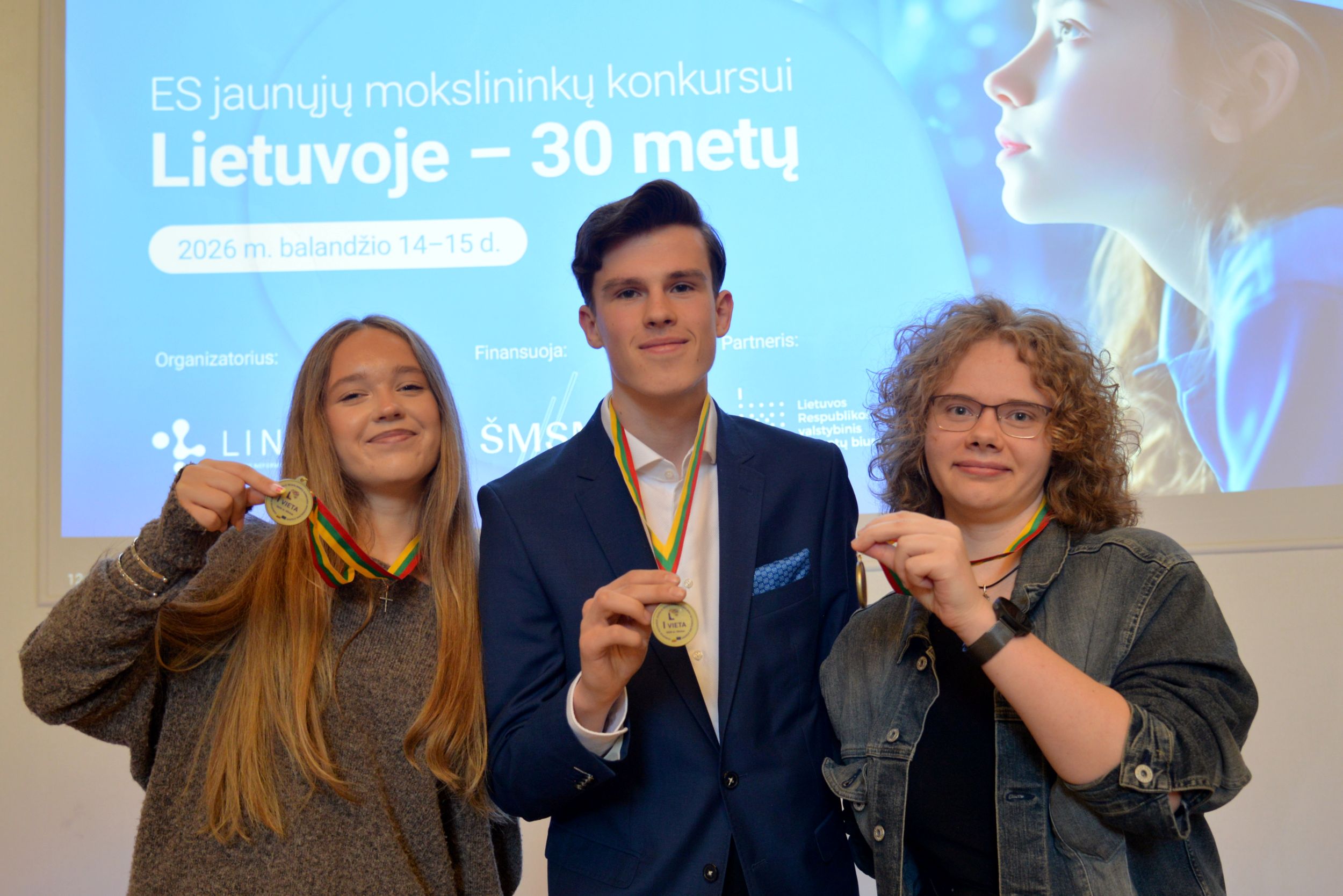
The results of the national round of the EU Contest for Young Scientists were announced on 15 April at the Ministry of Education, Science and Sport. The first prize winners are the authors of two scientific papers. They become candidates to represent Lithuania at the EU Contest for Young Scientists (EUCYS), which will take place in Kiel, Germany, in September this year. This annual competition showcases the best research carried out by students in the EU and beyond.
In the national stage of the competition, the first prize went to Jogailė Grincevičiūtė, a twelfth-grader from Vilnius Private Gymnasium, for her work “Synthesis of tetrafluorine-isobutylamine benzenesulfonamides and studies of inhibition of carbonic anhydrases isoforms I, II, IX” (supervisor Mantas Žvirblis). Jogailė came up with the idea for the research paper after a person close to her lost a family member due to cancer. “My research was aimed at finding out what molecule could inhibit enzymes associated with cancer,” says the winner.
Other first prize winners were tenth-grade students Aistis Domeika and Austėja Gudaitė from the Gymnasium of the Lithuanian University of Health Sciences for their paper “A new biomechanical principle in the production of sports insoles” (supervisor Rimtautas Gudas). “I go in for sports and we wanted to help others achieve better sports results, thus, we came up with the idea of developing insoles that would be affordable and personalised for everyone, not just professionals,” Aistis says.
The Minister of Education, Science and Sport Raminta Popovienė congratulated the participants and laureates.
The Contest in Lithuania held for 30 years already
Valdas Jankauskas, Director of LINEŠA, was pleased that the 30 years of Lithuania’s participation in the Contest have brought individuals who today continue their work in universities in Lithuania and around the world, have founded start-ups, work in high-tech companies, and are developing things that matter to society as a whole.
This year, a total of 26 works in different scientific fields were selected for the final national round of the EU Contest for Young Scientists, with 36 author students and 23 supervisors. The particicpants of the national round were judged and the winners were selected by a panel of scientists from different fields of research. The jury from the State Patent Bureau of the Republic of Lithuania, the partner of the Contest, also evaluated the papers and selected the most innovative ones.
Second prize winners
The second prize in this year’s national round of the EU Contest for Young Scientists went to Ignas Beniulis (supervisor Irena Skamarakienė, Marijampolė Rygiškių Jonas Gymnasium) for his paper “Tetracycle engine”.
Ignas was also awarded a cash prize from Julius Bogomolovas, a former laureate of the Contest and now a researcher at the University of California, San Diego. The work was also ranked 3rd in the World Intellectual Property Organisation (WIPO) Awards by the jury from the State Patent Bureau of the Republic of Lithuania.
Another second prize in the national stage of the EU Contest for Young Scientists went to Gertrūda Narauskaitė (supervisor Marta Marčiulionytė, Kaunas 7th Fortress), author of the paper “Anthocyanin-supplemented indicator strips for the determination of the quality of dairy products”. The jury from the State Patent Bureau also ranked the work 2nd.
The second prize was also awarded to Arielė Rupšė (supervisor Vilma Baužienė, Meridian Lyceum), author of the paper “Substrate-dependent Modulation of Amino Acid Composition in Fusarium venenatum: an Experimental and Genome Level Analysis”. Arielė also also won a special prize, a trip to the Swiss Talent Forum in September 2027.
Third prize winners
The third prize was awarded to Vytautė Stuopelytė, Adrija Kolomijec (supervisors Virginija Savickaitė, Danguolė Vaičekauskienė, Šiauliai Didždvaris Gymnasium) for their paper “Changes in biochemical parameters of Kale when grown in different soils”.
Another third prize was awarded to Ugnė Andriuškaitė (supervisor Vaidilutė Šepkauskienė, Ramučiai Gymnasium, Naujoji Akmenė) for her paper “Antioxidant properties of the fruits of Rosa canina at the stage of ripeness”.
The third prize was also awarded to Lijana Airapetian and Maksim Korovin (supervised by Benedikt Bachmetjev, Rasa Gymnasium of Vytautas Magnus University, Klaipėda Žaliakalnis Gymnasium), authors of the paper “Integration of Large Language Models (LLM) for streamlining outpatient clinical documentation: a cross-sectional study of the impact of in-house software on the working time and cognitive load of doctors”. The work also won first prize at the World Intellectual Property Organisation (WIPO) awards.
Another third prize winners were Eglė Norvilaitė and Erikas Suchanovas (supervised by Daiva Urbštienė, Palanga Old Gymnasium), the authors of the paper “The effect of Furcellaria lumbricalis on the growth, biomass increase and nutritive value of mealworms”.
Letters of Commendation given to: Gerda Stralkutė and Airida Baliūnaitė for “When to put honey in tea?” (supervisor Sigita Dzimijonienė, Liudvinavas Kazys Boruta Gymnasium); Lukas Mockus and Erikas Volodko for their work “Feasibility study on obtaining biofuels (biogas, bioethanol and biodiesel) domestically” (supervisor Jūratė Paukštienė, Vilnius Simonas Daukantas Gymnasium); Elena Visakavičiūtė for the work “The change of the Baltic Sea coast in Klaipėda in 2025” (supervisor Solvita Dimienė, Ąžuolynas Gymnasium in Klaipėda); Andrėja Jokubynaitė, for the work “The effect of different heating temperatures on the formation of fatty acid oxidation products in seeds” (supervisor Daiva Paškauskienė, Aušra Gymnasium in Vilkaviškis); Paulina Rutkauskaitė for her work “Empirical analysis of margins of accuracy of amateur astronomical observations of Jupiter satellite orbits” (supervised by Kęstutis Kulikauskas, Panevėžys Gymnasium No 5); Ugnė Karečkaitė for her work “Synthesis of a bioplastic seed film based on starch and its market equivalence” (supervised by Marta Marčiulionytė, Kaunas 7th Fortress); Emilė Kniuliūtė for her work “Dependence of growth rate and frequency of cannibalism in narrow-clawed crayfish (Astacus leptodactylus) on the food source” (supervisor Indrė Mačiulskė, Vėtrungė Gymnasium, Klaipėda); Smiltė Vaičiukynė, for her work “NileBright analyzer™ - a detector of nanoplastics for laboratory and environmental research” (supervisor Vladimir Orlov, Kaunas 7th Fortress); Ignas Ereminas for his work “Investigation of prevalence of Borrelia burgdorferi sensu lato complex, agent of the Lyme disease, in Ixodes ricinus mites collected in the Antaniškiai forest in Radviliškis” (supervised by Lionė Semeniukienė, Lizdeika Gymnasium, Radviliškis).
The incentive prize from the State Patent Bureau went to Kipras Lukoševičius (supervisor Ignas Jurčiukonis, Engineering Lyceum of Vilnius Gediminas Technical University), author of the work “Development of engineering solutions to reduce school canteen queues and increase the number of seats”.
Another incentive prize from the Patent Bureau was awarded to Lukas Mockus and Erikas Volodko (supervised by teacher-methodologist Jūratė Paukštienė, Vilnius Simonas Daukantas Gymnasium) for their paper “Feasibility study on obtaining biofuels (biogas, bioethanol and biodiesel) domestically”.
An invitation to the international world of science
The EU Contest for Young Scientists is the major science fair for schoolchildren in the European Union, bringing together thousands of participants. Each year, the event brings together promising, talented students and bright young minds (14-20 years old) to enable them to present their projects to an international panel of judges. It is the only competition in the EU where the scope and quality requirements for students’ projects match those for research.
The place where future discoveries are born
Lithuania’s journey in the EU Contest for Young Scientists began in 1996, when the country became eligible to organise the national round and to delegate its representatives to the international contest. From 1997 to 2025, Lithuania has won as many as 27 prizes: 2 first prizes, 3 third prizes and 22 special prizes.
In 2011 in Helsinki, Finland, Povilas Kavaliauskas won the first prize with his project “The role of house flies (Musca domestica) in the dissemination of resistant strains of bacteria”; in 2022 in Leiden, the Netherlands, Meda Surdokaitė won the first prize for her work “Optimisation of the synthesis of the fluorescent dye Nile Red”.
In 2004, Laurynas Pliuškys was awarded third prize in Dublin, Ireland, for his project “Hydrochemical studies of a Lake in Trakai”. In 2014, Matas Navickas won the third prize in Warsaw, Poland, with his paper “Generation of flowers of apple tree Malus x robusta in vitro”. Kamilė Milkintaitė won the third prize in Katowice, Poland, in 2024 for her project “Towards a more advanced treatment of brain tumours: new therapeutic and diagnostic targets”.
The international round of the EU Contest for Young Scientists is organised each year by the European Commission in partnership with a national coordinator that is different each time.
The national phase of the Contest is organised by the Lithuanian Non-formal Education Agency (LINEŠA) and funded by the Ministry of Education, Science and Sport. The State Patent Bureau is a partner of the Contest.
Information and photo by LINEŠA
Last updated: 23-04-2026
Related news:
Lithuania presented the priorities of Lithuania’s Presidency of the European Schools system at CULT